
Change Default Installation Directory In Windows 1. I redirected the installation path for my Program Files from C: \ to P: \ following the directionsfrom all the posts shown in the topic at http: //www. I have Windows 7 Home Premium 6.
I followed the suggestions for my system using the followinginformation: The end result was I did not use the regular REGEDIT but the one suggested by typing in Run: %systemroot%\syswow. Were there any disadvantages by using this version of Regedit? I understood that I now was to have a P: \Program Files and a P: \Program Files (x. What I ended up with is: P: \Program Files; P: \Program Files. P: \Program Files (8.
P: \Program Files (8. P: \Program Files (x. P: \Program Files (x. I believe I figured out that I have two folders in each category because I made a folder in the new P: \drive to copy everything from C: \ into instead of just copying it the the P: \ drive without indicating a folder. Get rid of the folder within the folder? Or would it just be easier (or perhaps the only way) to format and re- install Windows and start from scratch?
I tried to pull up both versions of Regedit to see what was showing and perhaps changing things back to C: \. The error message said perhaps it had been moved. Which I’m sure I did, but do not know how to locate it. The regular Regedit did not show anything at all for the things I redirected. I redirected my program files using the regular Regedit once prior to this time, which I had formatted and re- installed Win 7 so thought I’d do an even better job using the one supposedly for 6. The first time using the regular Regedit allowed me to go back in and change them back to C: \ from P: \. I was trying to re- install using the Recovery Partition, which required I put the installation path back to C: \ before I could.
If I ever need to (and I will) re- install Win 7 again, I would now have to use the system image as there is no where I can see to change things back. If the system image goes wrong, it appears I’ll be up a creek. I finally discovered how I could make recovery disks but am unclear whether I would need to change the P: \ back to C: \.
If you are using Windows Vista or Windows 7 and need to map a drive to an iSeries IFS directory you will need to follow the steps below: Open the Local Security. Just follow these 15 steps to change the drive letter of your hard drive, flash drive, or disc drive. Works on Windows 7, Vista, and XP. Go to Change and choose the letter for your partition from Assign the following drive letter: Click OK, close all windows and restart your computer. After Moving the Hard Drive or the Motherboard Change. There are 2 different Boot CD’s that can do this for you, Hiren’s Boot CD (v10.2 and newer) and Ultimate. Tools to scan, monitor or repair hard drives (HDD). This little tool will set the dirty bit flag on a drive. When the dirty bit flag is set, Windows will perform a.
In Windows operating system since Windows Vista, if for whatever reason the drive letter or paths assignment to a disk drive, CD or DVD drive, flash memory disk drive. How to Change a Drive Letter Don't Like the Letters Assigned to Your Drives in Windows? Change Them! Share Pin Email. I tried to make PEN drive bootable with the software but no luck. Even i have to face one more problem. Accidently i choose my another hdd 2nd partition (E). There are two options to change a hard drive from FAT32. You can use the Convert.exe command from a command prompt in the Windows Operating System (OS) or.
I don’t think so, but I am pretty confused at this point. I did a complete system image prior to installing Acronis Disk Director and partitioning, then redirecting the installation path. I’ve never had any success backing up anything. I have never tried a system image restoration, so not sure how reliable they are. I really just want to set everything up ascustomized and streamlined as possible and attempt a complete system image containing the way I’dwant Windows to load up just the pre- installed programs of my choice, not theirs.

Without unnecessaryduplication of files or folders. Would anyone be able to solve any of my questions? I know this will work just great once I’ve worked out the wrong turns taken! Thanks for any help!!

How to Format a Hard Drive (Windows 1. Vista, XP)You need to format a hard drive if you plan on using it in Windows. To format a hard drive means to delete any information on the drive and to set up a file system so your operating system can read data from, and write data to, the drive.
As complicated as that might sound, it's not really difficult to format a hard drive in any version of Windows. This ability is a very basic function that all operating systems have, and Windows makes it pretty easy. Important: If the hard drive you want to format has never been used, or was just wiped clean, it must first be partitioned. See How to Partition a Hard Drive in Windows for instructions.
Once partitioned, return to this page for help formatting the drive. Time Required: The time it takes to format a hard drive in Windows depends almost entirely on the drive's size, but your computer's overall speed plays a part too. Follow the easy steps below to format a hard drive in Windows 1. Windows 8, Windows 7, Windows Vista, or Windows XP: How to Format a Hard Drive in Windows.
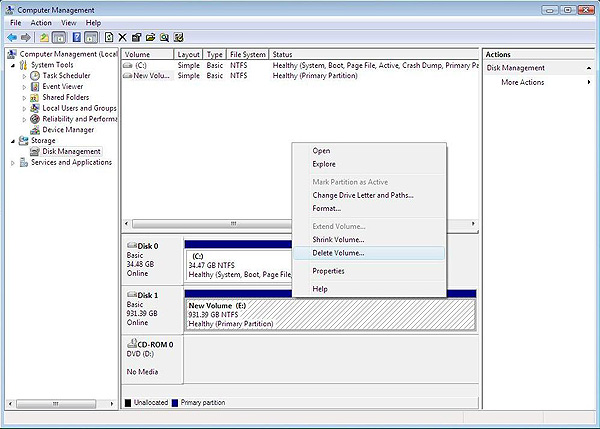
Optional Walkthrough: If you'd prefer a screenshot- based tutorial, skip the instructions below and try my Step by Step Guide to Formatting a Hard Drive in Windows instead! Open Disk Management, the hard drive manager included with all versions of Windows. Note: In Windows 1. Windows 8, the Power User Menu gives you the quickest access to Disk Management. You can also open Disk Management from the Command Prompt in any version of Windows but opening it via Computer Management is probably easier unless you're really quick with commands.
See What Version of Windows Do I Have? If so, it means you still need to partition the drive. See How to Partition a Hard Drive in Windows and then return here to continue. Note: Formatting the C drive, or whatever letter happens to identify the drive that Windows is installed on, can not be done from Disk Management.. See How to Format C for instructions on how to format your primary drive. Once located, right- click or tap- and- hold on the drive and choose Format.. Once started, you can't stop a format without causing problems.
So.. If you're formatting a drive that has data on it, double- check that it's the correct drive by looking at the drive letter and then checking in File Explorer or Windows Explorer (depending on your version of Windows) that it is, in fact, the correct drive. If you're formatting a new drive, the drive letter assigned should be unfamiliar to you and the File System will probably be listed as RAW. In the Volume label: textbox, either give a name to the drive or leave the name as is. If this is a new drive, Windows will assign the volume label.
New Volume. I recommend giving a name to the drive so it's easier to identify in the future. For example, if you're planning on using this drive to store movies, name the volume Movies.
For File system: choose NTFS unless you have a specific need to choose another file system. NTFS is always the best file system option to use in Windows unless you have a specific need to choose FAT3. Other FAT file systems are only available as options on drives 2 GB and smaller. Set the Allocation unit size: set to Default unless there's a specific need to customize it.
There are very few reasons to change this. In Windows 1. 0, 8, and 7, the Perform a quick format option is checked by default but I recommend unchecking the box so a . A quick format skips the bad sector search and basic data sanitization. Windows XP: In a standard format, each sector is checked for errors. The quick format skips this check. Automatic data wiping during the format process isn't available in Windows XP.
The Enable file and folder compression option is unchecked by default and I recommend keeping it that way. Note: File and folder compression can be enabled to save on disk space and you're welcome to enable it if you think you may benefit from it.
However, most drives are so large today that the tradeoff between the saved space and lower drive performance probably aren't worth it. Tap or click OK at the bottom of the window. Tap or click OK to the .
Back up any data you want to to keep before formatting. Do you want to continue? You can keep track of the drive format by watching the Formatting: xx% progress in the Status field. Note: Formatting a hard drive in Windows could take a very long time if the drive is large and/or slow. A small 2 GB hard drive might only take several seconds to format while a 2 TB drive could take considerably longer depending on the speed of the hard drive and the computer as a whole. The format is complete when the Status changes to Healthy, which will happen a few seconds after the format counter reaches 1. Windows does not otherwise notify you that the drive format is complete.
That's it! You've just formatted or reformatted, your hard drive and you can now use the drive to store files, install programs, backup data.. Depending on your version of Windows, and the type of format, it's possible the data is still there, hidden from Windows and other operating systems but still accessible in certain situations. See How to Wipe a Hard Drive for instructions on truly removing all the information on a hard drive and my Wipe vs Shred vs Delete vs Erase: What's the Difference? See How to Completely Erase a Hard Drive for more on these other methods.
More on Formatting Hard Drives in Windows. If you want to format your hard drive so you can install Windows again from scratch, please know that your hard drive will be automatically formatted as part of that process. See How to Clean Install Windows for more on that. Not happy with the drive letter that Windows assigned during the partitioning process? You're welcome to change it at any time! See How to Change Drive Letters in Windows to see how. You can also format a hard drive via Command Prompt using the format command.
See my Format Command: Examples, Switches, & More for details on how to do that.


/https%3A%2F%2Fimage.slidesharecdn.com%2Fpuntosenautocad-160520024627%2F95%2Fpuntos-en-autocad-2-638.jpg%3Fcb%3D1463712412)
/http%3A%2F%2Fk32.kn3.net%2Ftaringa%2F9%2FA%2FB%2F7%2F4%2F4%2FAlexbjm%2FA24.png)
/https%3A%2F%2Fphotos.zillowstatic.com%2Fp_e%2FIS27abdqu1g7b11000000000.jpg)
/http%3A%2F%2Fwww.nhvweb.net%2Fnhhs%2Fmath%2Ffiles%2F2013%2F07%2Fpeer-tutor4.jpg)